


Most of us have purchased honey in one-pound plastic squeeze bottles from local beekeepers or farmers’ markets. Perhaps you did not know that there is a secondary and more valuable product collected during honey extraction, beeswax! Beekeepers take care to extract all the honey they can without destroying the comb that their bees need to rear new bees and to store nectar, pollen, and honey. Harvesting both honey and wax is a delicate balancing act for the beekeeper.
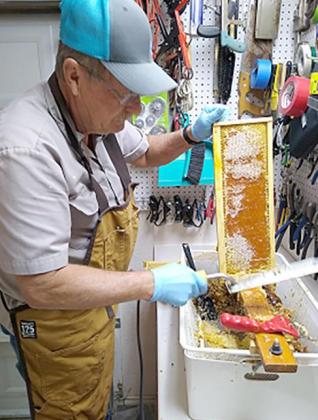
Beekeepers harvest wax from the bees in two basic ways. The first is as a result of the first step of honey extraction, “uncapping.” In the picture you see a beekeeping friend in our garage using a hot knife to slice open the light-colored wax caps on cells of honey. “Cappings wax” is the purist and most valuable honeybee wax; a one-hundred-pound honnot ey harvest yields about one pound of cappings wax. Commercial beekeepers mechanize the honey extraction process and yield huge volumes of honey and cappings wax, but the process is the same as for backyard beekeepers.
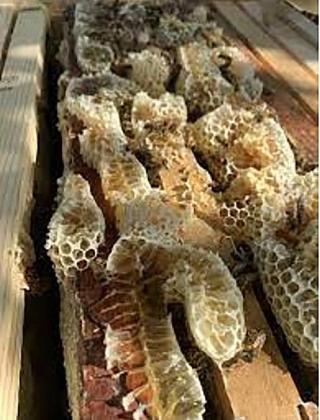
Beekeepers also collect wax in a covered bucket as they work a colony of bees. He or she will scrape away any beeswax that is not in the correct position on the frames and then store it in the freezer. Honeybees prefer order inside their hives. If the frames are too far apart, then bees build comb in the spaces between frames and on the tops and bottoms of frames. Local beekeepers called this “burr comb,” and many scrape it off and collect the wax. Burr comb can really make a mess and is a waste of the bees’ resources.
Wax harvest begins when the beekeeper gathers the dark, smashed collected wax, melts it slowly over a hot water bath or in a solar melter, and then filters it through successively closer- woven fabrics, such as old clean t-shirts or thin towels. What remains in the filter is typically dark and unappealing but makes great burn pile fire starters.
Next, beekeepers pour the final rendered wax into a mold for storage until processed into a final product. True beeswax will form a nice “blush” on the exterior after exposure to air for a time.
Finally, beekeepers get creative with their refined beeswax. Some sell the wax to commercial processors that supply it to the cosmetic and personal care companies or to industrial firms for lubrication formulations. We use our bees’ wax to make candles, lip balms, hand creams, skin care bars, and even wood preservative formulations. Our favorite is a beeswax lotion bar that softens dry winter-chapped skin.
Beeswax is an interesting product, made up of many different individual chemicals, based upon what nectar and pollen sources each colony of bees take in. The beeswax produced by one colony of honeybees may differ to a small degree from that produced by honeybees living 100 miles away.
Honeybee experts Sammataro and Avitabile in their book, The Beekeeper’s Handbook share these interesting facts about beeswax:
•Bees eat about 8 pounds of honey to produce 1 pound of beeswax
•1 pound of beeswax will make 35,000 wax cells, enough to put comb on both sides of five medium-sized frames
•A fully functioning hive contains about 10 total pounds of beeswax comb on the frames
•1 pound of beeswax stores about 22 pounds of honey
•There are 500,000 wax scales, each 1/8 inch in diameter, in one pound of beeswax
•Honeybees can only secrete wax at temperatures between 93 and 97 degF
•Under optimal conditions, 10,000 bees produce 1 pound of beeswax in three days (Farrs have seen colonies take a box of 10 frames with plastic foundation, “empties,” draw comb on it, and store it full of nectar in one week)
•Beeswax melts between 142 and 151 degF
•The flashpoint, when wax vapor ignites, is between 490-525 degF
•The relative density of beeswax is 0.963 at 20 degC; water is 1.0, so beeswax floats
•The accepted chemical formula for beeswax is C15H51C00C30H61; however, beeswax is made of more than 20 different compounds, some are still unidentified Some beekeepers consider handling beeswax as a distraction; to others it is a valuable starting material to make many other useful and valuable products.
Next time you meet a beekeeper, purchase some honey to support agriculture and local businesses.
Then, surprise him or her by asking about last year’s beeswax harvest! You might enjoy the hand lotion bar!