

“You have enemies? Good. That means you have stood up for something, sometime in your life.” Maybe Victor Hugo wrote that in his journal, or perhaps Winston Churchill penned it. Regardless, those sixteen simple words are profound. Stand up for something, and you will have enemies.
The Farrs have an enemy; his name is Satan. He really is out to get us, and the stakes are high. He uses his minions of lies, misinformation, innuendo, and confusion, along with our pride, jealousy, mistakes, and willful intents to distract us from Truth and to rob us of joy our Creator gives. This enemy hates it when we stand for Jesus.
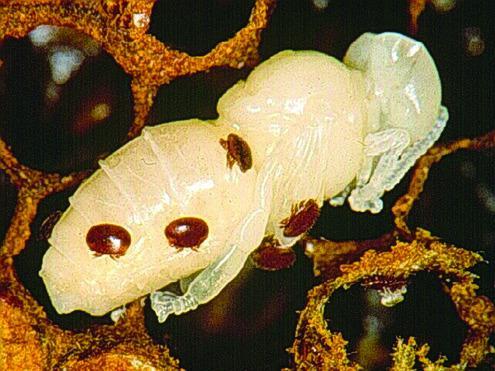
Beekeepers have an enemy; its name is Varroa. This mite is a reddish-brown parasite about the size of the head of a pin. The mite’s full name is Varroa destructor, and it is the U. S. honeybee industry’s ENEMY NUMBER ONE. This enemy is winning its war with honeybees and beekeepers.
The Honey Bee Health Coalition website, honeybeehealthcoalition. org, states, “Every honey bee colony in the United States and Canada either has Varroa mites today or will have them within several months.” This is diflarge ficult for new beekeepers to accept, since we cannot see most of the mites. They reproduce inside the wax cells on pupating honeybees and double their numbers in the colony every thirty days.
The mites feed on the fat (energy storage) bodies of the developing bee thus weakening it; they also inject viruses which can maim and disfigure the bee.
Many beekeepers underestimate Varroa destructors’ impacts – until they open a hive and find that there are no live bees in the boxes. Texas A&M entomologists state, “While Varroa mites do not kill adult honey bees, they can weaken and shorten individuals’ lifespans and will ultimately kill the colony by outcompeting their host.” A few brash lesser-experienced beekeepers claim, “Wax moths (or hive beetles) killed my bees.” No, sir or ma’am, they did not. Wax moths and hive beetles are the clean-up crews, just like buzzards among dead/injured cattle; they prey on the weak and finish off the job that the real enemy already achieved.
The Honey Bee Health Coalition further explains, “Since becoming a major pest of honey bees in the late 1980s, varroa mites to pose a serious threat to both US and Canadian beekeeping industries. Varroa mite infestation is ubiquitous and causes direct damage to developing pupae and adult bees and transmits virulent honey bee viruses. Chemical mitigation (use of a miticide) of varroa mites is often the most effective and economic solution, but mites have gained resistance to currently registered compounds and there are signs of emerging resistance to the most widely used miticide, Apivar.”
Unchecked varroa will kill approximately 50% of a beekeeper’s colonies every year and severely reduce their honey production and pollination efficiency. For the small-scale backyard beekeeper, this may be too much to digest so they leave the profession. With proper care and treatment of varroa and other honeybee maladies, small-scale beekeepers hold their yearly losses to about 10%. Commercial beekeepers are not able to give the same level of care and attention hence their losses are about 30% each year. Beekeepers can split their colonies each spring such that one colony becomes two thereby recoup-ing some of this yearly loss at the risk of losing some of their honey production.
It’s good to recognize your enemy so that you can take steps to stand up, steer clear and mitigate the enemy’s impact.
Beekeepers, and those who enjoy the benefits of honeybees, you have an enemy, and its name is Varroa destructor. Beekeepers, stand up to the fight going on inside your colonies right now. Steer clear of ignorance, wishful thinking, or what someone on social media suggested. Listen to the experts. Visit the Honey Bee Health Coalition at honeybeehealthcoalition. org and download the free “Varroa Management Guide.” Read all 37 pages and follow the recommendations of some of the best bee researchers in America.
Honey consumers and those with crops to be pollinated, remember the beekeepers and their fight against Varroa destructor as you consume your honey, vegetable, or fruit.
Friends and neighbors, do you have an enemy? “Good. That means you have stood up for something, at some time in your life.”