

We worked hard this morning gardening on our property, so we decided to get lunch at the Cason VFD barbecue fundraiser.
We had some great food (best beans in memory!) and met many interesting folks. A nice lady introduced herself, saw our very dirty Carhartt clothing, and asked, “What have you been up to today?” Roger smiled and replied, “I’ve been grafting persimmon trees.”
She was perplexed. “You can graft persimmon trees? Why would you want to? For the deer?” What ensued was a ten-minute conversation on trees, luscious persource, simmons, grafting, and what is ailing the trees in her yard. Ten minutes is not enough time to discuss persimmons, so we’ll continue the learning here, since that nice lady probably subscribes to this newspaper.
Trees have two main parts: roots and canopy. The root system transports water, oxygen, and nutrients, and it is the part below ground level. The canopy includes the trunk, branches, leaves, and fruit, which are all above ground. Normally, the roots and the canopy are from the original seed that produced the tree in the first place. A post oak acorn, if properly planted, will produce a post oak root system and a post oak canopy. However, with many fruit trees and some ornamentals, there may be a good reason to have the roots come from one plant and the canopy from another. When the two are put together, this is called grafting.
Grafting is nothing new. The Bible book of Romans, chapter 11 verse 17, speaks about grafting: “But if some of the branches were broken off, and you, being a wild olive, were grafted in among them and became partaker with them of the rich root of the olive tree…” The Apostle Paul wrote in about 60 A.D. to an agrarian society to describe the root of God’s family, the breaking off of some Jewish branches, and the grafting in of Gentile branches. Earlier, Aristotle in approximately 350 B.C. discussed the process of grafting plants to achieve better results.
Okay, back to persimmons and the nice lady’s question. Yes, we can graft persimmon trees, and yes, we do it intentionally. Our native American persimmon, Diospyros virginiana (D. virginiana) grows wild in East Texas, but many consider it a trash tree only capable of producing small seeded fruit for wildlife.
However, D. virginiana is resistant to cotton root rot and root knot nematodes, both of which plague our soils and can cause plant death. So…if we could put a wonderful fruiting variety of persimmon on top of the D. virginiana root stock, we might have a winner!
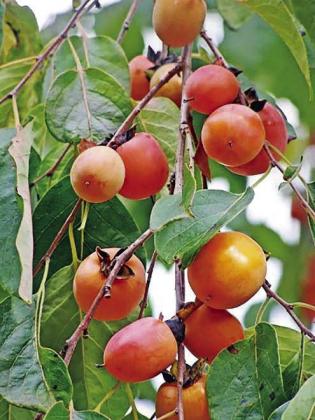
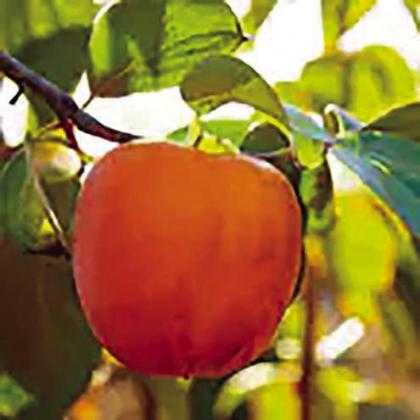
The Japanese have developed many wonderful varieties of persimmon over the years that are easy to grow, taste like a crunchy apple, and do not result in alum “pucker mouth,” like an unripe D. virginiana persimmon.
However, the straight Japanese persimmons succumb to cotton root rot and die before fruiting in our East Texas soils. Researchers saw this as a perfect opportunity to graft a Japanese canopy onto a native American root stock to get the best of both. Commercial persimmon growers now graft these trees and sell them to local nursery suppliers for resale to you and us.
Roger attended an Texas A&M AgriLife grafting workshop in Ft. Worth recently and learned to produce new Japanese persimmon trees. The root stock, foreground, came from seed he collected two years ago from a neighbor’s wild persimmon fruit and germinated. The Japanese “scion wood,” the prospective canopy, came from purchased Japanese persimmon trees we planted in our orchard several years ago. Scion wood is a twig from a desirable parent plant, with two or more buds, and capable of being joined to a root stock – grafting.
Persimmons come in two types, those that are ripe when soft (astringent) and those that are ripe when orange (non-astringent). As-tringent varieties are Hachiya and our native American persimmon. Hachiya is the persimmon we normally see in grocery stores in late fall. Non-astringent varieties are Fuyu, Izu, and Fuyagaki. The Farrs eat the flatter non-astringent Fuyu and its derivative varieties straight from the tree just like apples in the fall. We can’t leave the fruit on too long, or the racoons will eat it all!
Bottom line, yes, ma’am, we can graft persimmons. We graft to get yummy fruit off an otherwise not very useful plant. No, ma’am, it’s not for the deer. We graft wild persimmons so WE CAN EAT THEM!
Somewhere in Cason there is a nice lady who is right now having a discussion with her husband or friend about grafted Japanese persimmons. Would you please let her know that we have some scion wood available for her?